The plumbing industry remains a large, essential service market in 2026, with demand supported by new construction, remodeling, leak repair, water-efficiency upgrades, and aging infrastructure. The figures below are primarily U.S.-focused because the newest official labor, housing, and water-use data are published most consistently in the United States.
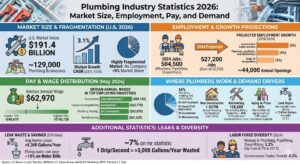
Key plumbing industry statistics
- The U.S. plumbers industry is worth $191.4 billion in 2026.
- There are about 129,000 plumbing businesses in the United States in 2026.
- The market has grown at a 3.1% CAGR from 2021 to 2026.
- The industry is highly fragmented, with no company holding more than 5% market share.
- Plumbers, pipefitters, and steamfitters held about 504,500 jobs in 2024.
- BLS projects employment to reach about 527,200 by 2034, a gain of 22,700 jobs.
- The occupation is projected to grow 4% from 2024 to 2034, with about 44,000 openings per year.
- The median annual wage for plumbers, pipefitters, and steamfitters was $62,970 in May 2024.
- The lowest 10% earned under $40,670, while the highest 10% earned over $105,150.
- 66% of plumbers worked for plumbing, heating, and air-conditioning contractors, while 8% were self-employed.
- In the broader NAICS 238220 industry, employers supported about 1,236,740 jobs in 2023, including 308,840 plumbers, pipefitters, and steamfitters.
- Privately owned U.S. housing completions ran at a seasonally adjusted annual rate of 1.527 million in January 2026, including 970,000 single-family completions.
- NAHB says there were 128,000 remodeling firms at the start of 2025, and home improvement spending rose to 44% of residential construction spending in the first quarter of 2025.
- 56% of remodelers report doing aging-in-place work, and 73% say requests for aging-in-place features have increased over the past five years.
- EPA says household leaks waste nearly 1 trillion gallons of water annually, and the average home loses more than 9,300 gallons per year to leaks.
- Fixing easily corrected household leaks can save homeowners about 10% on water bills.
Plumbing market size and business structure
IBISWorld estimates the U.S. plumbers industry at $191.4 billion in 2026, up slightly from $190.6 billion in 2025. It also estimates roughly 129,000 businesses operating in the industry this year. That combination points to a large but still highly fragmented market, especially because no single company controls more than 5% share.
That fragmentation matters because it means the plumbing market is still dominated by local and regional operators rather than a handful of national giants. For contractors, that usually translates into strong local competition, service-area economics, and recurring demand from repairs and replacement work rather than winner-take-all national consolidation.
Employment and wage statistics
The latest BLS occupation data show plumbers, pipefitters, and steamfitters held about 504,500 jobs in 2024. BLS projects that total to rise to 527,200 by 2034, which implies 22,700 additional jobs over the decade and about 44,000 openings per year on average.
Pay also remains competitive relative to the overall labor market. The median annual wage for the occupation reached $62,970 in May 2024, compared with $56,490 for construction trades workers overall and $49,500 across all occupations.
BLS also shows meaningful upside for experienced workers. The bottom 10% of plumbers, pipefitters, and steamfitters earned less than $40,670, while the top 10% earned more than $105,150. In the top industries employing these workers, median annual wages ranged from $61,620 in manufacturing to $69,160 in government roles outside schools and hospitals.
Where plumbers work
The occupation remains heavily concentrated in contractor work. BLS reports that 66% of plumbers, pipefitters, and steamfitters worked for plumbing, heating, and air-conditioning contractors in 2024, while 8% were self-employed. Heavy and civil engineering construction accounted for 4%, and government and manufacturing each accounted for 3%.
On the employer side, the broader NAICS 238220 industry supported about 1,236,740 total jobs in 2023. Within that industry, BLS counted about 308,840 plumbers, pipefitters, and steamfitters and an annual mean wage of $68,570 for that occupation.
Demand drivers for the plumbing industry
New construction remains a major source of plumbing demand. The U.S. Census Bureau reported privately owned housing completions at a seasonally adjusted annual rate of 1.527 million in January 2026, including 970,000 single-family completions. Each completed unit feeds demand for rough-in plumbing, fixture installation, water heating, drainage, and later repair work.
Remodeling is another major growth engine. NAHB said there were 128,000 remodeling firms at the start of 2025, while home improvement’s share of residential construction spending rose from 33% in 2007 to 44% in the first quarter of 2025. That shift matters for plumbers because kitchens, bathrooms, accessibility upgrades, and replacement fixtures are all plumbing-intensive project categories.
Aging-in-place work is also becoming more important. NAHB reported that 56% of remodelers are involved in home modification work related to aging-in-place, and 73% said requests for aging-in-place features have increased significantly or somewhat over the last five years. That trend supports ongoing demand for shower retrofits, grab-bar-ready bathroom updates, fixture replacements, and accessibility-focused plumbing work.
Leak repair and water-efficiency statistics
Leak repair remains one of the clearest recurring service opportunities in plumbing. EPA says household leaks waste nearly 1 trillion gallons of water annually nationwide, while the average household’s leaks account for more than 9,300 gallons of wasted water every year. EPA also says 9% of homes have leaks that waste 50 gallons or more per day.
Those numbers have a direct revenue implication for service plumbers because many common leak issues are relatively small repairs with measurable savings. EPA estimates that fixing easily corrected household water leaks can save homeowners about 10% on their water bills. A faucet dripping once per second can waste more than 3,000 gallons per year, and a showerhead leaking at 10 drips per minute can waste more than 500 gallons per year.
Labor force diversity statistic
Women remain underrepresented in the trade, but participation has increased. IWPR reported that women held 3.2% of plumber, pipefitter, and steamfitter jobs in 2024, up from 0.7% in 2015. That still leaves plumbing below the already-low 4.3% female share across construction trades overall.
Chart: Projected employment growth, 2024 to 2034
| Label | Bar | Value | ||
|---|---|---|---|---|
| Construction trades workers |
|
6% | ||
| Plumbers, pipefitters, and steamfitters |
|
4% | ||
| Total, all occupations |
|
3% |
Max = 6%. Widths: Construction trades workers 100.00%, Plumbers, pipefitters, and steamfitters 66.67%, Total, all occupations 50.00%.
Chart: Median annual wages in top employing industries
| Label | Bar | Value | ||
|---|---|---|---|---|
| Government, excluding state and local education and hospitals |
|
$69,160 | ||
| Heavy and civil engineering construction |
|
$62,770 | ||
| Plumbing, heating, and air-conditioning contractors |
|
$62,670 | ||
| Manufacturing |
|
$61,620 |
Max = $69,160. Widths: Government, excluding state and local education and hospitals 100.00%, Heavy and civil engineering construction 90.76%, Plumbing, heating, and air-conditioning contractors 90.62%, Manufacturing 89.10%.
Bottom line
The most important plumbing industry statistics for 2026 point to a market that is large, fragmented, and structurally supported by recurring demand. New construction, remodeling, aging-in-place projects, leak repair, and water-efficiency upgrades all continue to reinforce the long-term need for skilled plumbers, while BLS pay and job-growth figures show the trade remains economically attractive.
Sources
- U.S. Bureau of Labor Statistics, Occupational Outlook Handbook: Plumbers, Pipefitters, and Steamfitters
- U.S. Bureau of Labor Statistics, OEWS industry-specific estimates for NAICS 238220
- IBISWorld, Plumbers in the US Industry Analysis and Market Size Statistics
- U.S. Census Bureau, New Residential Construction Press Release, January 2026
- National Association of Home Builders, Remodeling Growth and Aging-in-Place data
- U.S. Environmental Protection Agency WaterSense, Fix a Leak Week
- Institute for Women’s Policy Research, Women Working in Construction, August 2025
