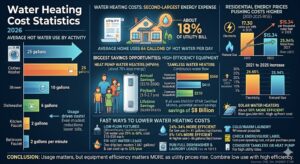
Water heating remains one of the most important utility cost categories in the typical U.S. home. The latest data shows that costs are shaped by three main factors: how much hot water a household uses, what electricity or natural gas costs locally, and which water heater technology is installed. The statistics below show where water heating costs come from and where the biggest savings opportunities now sit.
All figures below are U.S. figures unless otherwise noted.
water heating cost statistics
Key water heating cost statistics
Water heating is the second-largest energy expense in many homes and accounts for about 18% of the utility bill.
The average home uses about 64 gallons of hot water per day.
A clothes washer uses about 25 gallons of hot water per use, a shower about 10 gallons, and a dishwasher about 6 gallons.
U.S. residential electricity averaged 17.30 cents per kWh in 2025, up 26.65% from 2021.
U.S. residential natural gas averaged $15.34 per thousand cubic feet in 2025, up 25.94% from 2021.
ENERGY STAR certified heat pump water heaters use about 70% less energy than standard electric water heaters.
A 4-person household can save about $550 per year with an ENERGY STAR certified heat pump water heater.
A 3-person household can save about $410 per year, and a 2-person household about $270 per year.
For a 4-person household, the typical heat pump water heater payback is about 2.7 years.
If all electric water heaters sold in the U.S. were ENERGY STAR certified heat pump models, annual energy cost savings would rise to about $8 billion.
Tankless water heaters can be 24% to 34% more efficient than storage tank models in homes using 41 gallons of hot water per day or less.
In higher-use homes around 86 gallons per day, tankless units are still about 8% to 14% more efficient.
An ENERGY STAR qualified tankless water heater can save $100 or more annually.
Tankless water heaters typically last more than 20 years, versus 10 to 15 years for storage tank models.
Solar water heaters are about 50% more efficient than gas or electric water heaters, although their upfront costs are higher.
Low-flow fixtures typically cost about $10 to $20 each and can cut water use by 25% to 60%.
A leak of one drip per second wastes 1,661 gallons of water and can cost up to $35 per year.
Dishwashers with booster heaters typically pay back their extra cost in about 1 year when paired with a lower water heater temperature setting.
Inefficient clothes washers can cost three times as much to operate as efficient models.
Average hot water use by activity
Usage drives water heating costs just as much as fuel prices do. Laundry and showers dominate hot water demand, which is why fixture upgrades and appliance efficiency can reduce bills quickly.
Because the average home uses 64 gallons of hot water per day, even modest reductions in showers, faucet minutes, or hot laundry cycles can noticeably lower water heating costs.
Residential energy prices have pushed water heating costs higher
Water heating costs do not rise only because people use more hot water. They also rise when residential electricity and natural gas prices climb. The latest complete annual EIA data shows that both fuels were materially more expensive in 2025 than in 2021.
Year
Residential Electricity
Residential Natural Gas
2021
13.66 cents per kWh
$12.18 per thousand cubic feet
2022
15.04 cents per kWh
$14.75 per thousand cubic feet
2023
16.00 cents per kWh
$15.40 per thousand cubic feet
2024
16.48 cents per kWh
$14.50 per thousand cubic feet
2025
17.30 cents per kWh
$15.34 per thousand cubic feet
2021 to 2025 increase in residential energy prices
Label
Bar
Value
Electricity
26.65%
Natural Gas
25.94%
Max = 26.65. Widths: Electricity 100.00%, Natural Gas 97.34%.
Electricity rose slightly faster than residential natural gas over the period, but both fuels increased enough to make water heating more expensive for households that did not reduce hot water use or upgrade equipment.
Heat pump water heater savings statistics
Heat pump water heaters currently offer the strongest operating-cost reduction in the mainstream residential market, especially for households replacing standard electric storage tanks.
Household Size
Annual kWh Savings
Annual Bill Savings
Payback
Lifetime Savings
2 people
1,880 kWh
$270
5.5 years
$2,050
3 people
2,820 kWh
$410
3.7 years
$3,830
4 people
3,760 kWh
$550
2.7 years
$5,610
Annual bill savings from an ENERGY STAR certified heat pump water heater
For a 4-person household, $550 in annual savings works out to about $45.83 per month. That makes heat pump water heaters one of the clearest cost-reduction upgrades available for all-electric hot water systems.
Water heater type and cost impact
Water Heater Type
Cost Statistic
Why It Matters
Storage tank
Typical lifespan of 10 to 15 years
Usually lower upfront purchase cost, but it stores hot water continuously and can lose heat while sitting idle.
Tankless
8% to 34% more efficient and $100 or more in annual savings
Cuts standby losses and usually lasts more than 20 years, but the upfront cost is higher.
Heat pump
About 70% less energy use and $270 to $550 annual savings
The strongest operating-cost reduction for homes replacing standard electric water heaters.
Solar
About 50% more efficient than gas or electric water heaters
The fuel source is free, but system cost is usually much higher upfront.
The main cost tradeoff is simple: storage tanks are cheaper to buy, while tankless, heat pump, and solar systems can be much cheaper to run over time.
What lowers water heating costs fastest
Install low-flow showerheads and faucet aerators first, because they are inexpensive and directly cut hot water use.
Fix even slow hot-water leaks quickly, because small leaks waste both water and heating energy.
Run full dishwasher and laundry loads to reduce the number of hot-water cycles.
Use warm or cold settings for laundry whenever possible.
Check the yellow EnergyGuide label before buying a new water heater so you compare annual operating cost, not just purchase price.
Consider tankless or heat pump models when replacing an older system, especially if utility rates in your area are high.
Conclusion
The biggest water heating cost statistics point to the same conclusion: usage still matters, but equipment efficiency now matters more than ever because residential utility prices have risen. Homes that combine lower hot water use with a higher-efficiency water heater have the clearest path to lower long-term water heating costs.
Sources
U.S. Department of Energy, Water Heating
U.S. Department of Energy, Reduce Hot Water Use for Energy Savings
U.S. Department of Energy, Tankless or Demand-Type Water Heaters
U.S. Department of Energy, Which Water Heater Is Right for You?
U.S. Department of Energy, Estimating Costs and Efficiency of Storage, Demand, and Heat Pump Water Heaters
U.S. Energy Information Administration, Electric Power Monthly, Table 5.3
U.S. Energy Information Administration, Natural Gas Residential Price Summary
ENERGY STAR, Save More with ENERGY STAR Certified Heat Pump Water Heaters
Keep your energy costs low with the top 10 low flow tankless water heaters that promise efficient hot water on demand; discover the best options available!