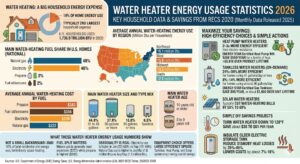
Water heater energy usage remains one of the biggest utility loads in U.S. homes. As of March 2026, the most detailed household-level water-heating figures available come from the U.S. Energy Information Administration’s 2020 Residential Energy Consumption Survey, with monthly water-heating appendices released in 2025. Those figures show that water heating is still a major residential energy expense, and that usage changes meaningfully by fuel, region, and equipment type.
Water heating accounts for about 18% of home energy use and is typically the second-largest household energy expense.
U.S. households used 1,736.9 trillion Btu for water heating in 2020.
The average household using water heating consumed 14.1 million Btu per year.
The average household using water heating spent $287 per year on water heating in 2020.
Homes using electricity for water heating averaged 2,706 kWh per year.
Homes using natural gas for water heating averaged 18.2 million Btu per year, equal to about 180.6 hundred cubic feet of gas.
Electricity used for residential water heating totaled 156.2 billion kWh in 2020.
Natural gas used for residential water heating totaled 1,075.8 billion cubic feet in 2020.
Main water-heating fuel was almost evenly split nationally: 48% natural gas and 46% electricity.
Only 3% of homes used propane as the main water-heating fuel, while 2% used fuel oil or kerosene.
The Northeast had the highest average annual water-heating use at 16.1 million Btu per household using the end use.
The South had the lowest average among the four major regions at 12.0 million Btu.
Average annual water-heating expenditure by fuel was $222 for natural gas, $339 for electricity, $383 for propane, and $356 for fuel oil or kerosene.
44.8% of homes had a 31- to 49-gallon main water heater in 2020.
37.9% of homes had a 50-gallon-or-larger main water heater.
6.5% of homes had a tankless main water heater.
31.5% of main water heaters were 5 to 9 years old.
36.0% of main water heaters were 10 years old or older.
For homes using 41 gallons or less of hot water daily, tankless water heaters can be 24% to 34% more energy efficient than conventional storage tank models.
For homes using around 86 gallons of hot water per day, tankless models can still be 8% to 14% more energy efficient than conventional storage tanks.
Heat pump water heaters can be two to three times more energy efficient than conventional electric resistance water heaters.
ENERGY STAR certified heat pump water heaters can save a household of four about $550 per year on electric bills and more than $5,610 over the product lifetime compared with a standard electric water heater.
ENERGY STAR certified gas tankless water heaters can save a family of four about $95 per year, or about $1,800 over the unit lifetime, compared with a standard gas storage model.
Solar water heaters typically cut water-heating bills by 50% to 80%.
Turning a water heater down to 120°F can save about $36 to $61 per year.
Insulating an older electric storage tank can reduce standby heat losses by 25% to 45% and lower water-heating costs by about 7% to 16%.
Main Water-Heating Fuel Share in U.S. Homes
Label
Bar
Value
Natural gas
48%
Electricity
46%
Propane
3%
Fuel oil/kerosene
2%
Max = 48%. Widths: Natural gas 100.00%, Electricity 95.83%, Propane 6.25%, Fuel oil/kerosene 4.17%.
Average Annual Water-Heating Energy Use by Region
Label
Bar
Value
Northeast
16.1 million Btu
West
15.9 million Btu
Midwest
14.3 million Btu
South
12.0 million Btu
Max = 16.1 million Btu. Widths: Northeast 100.00%, West 98.76%, Midwest 88.82%, South 74.53%.
Average Annual Water-Heating Cost by Fuel
Label
Bar
Value
Propane
$383
Fuel oil/kerosene
$356
Electricity
$339
Natural gas
$222
Max = $383. Widths: Propane 100.00%, Fuel oil/kerosene 92.95%, Electricity 88.51%, Natural gas 57.96%.
Main Water Heater Size and Type Mix
Label
Bar
Value
31 to 49 gallons
44.8%
50 gallons or more
37.9%
30 gallons or less
10.8%
Tankless
6.5%
Max = 44.8%. Widths: 31 to 49 gallons 100.00%, 50 gallons or more 84.60%, 30 gallons or less 24.11%, Tankless 14.51%.
What These Water Heater Energy Usage Numbers Show
The biggest takeaway is that water heating is not a small background load. In the latest detailed U.S. household data, it represents 18% of total residential site energy use, which puts it behind space heating but ahead of many other major appliances. That is why water-heating fuel, heater size, and equipment efficiency have such a visible impact on annual utility bills.
The fuel split also matters. Natural gas and electricity dominate U.S. water heating, but average annual water-heating expenditures differ a lot by fuel. In the 2020 RECS averages, natural gas water heating was the least expensive of the four major fuels at $222 per household using the end use, while propane was the highest at $383.
Seasonality is real even for water heating. EIA’s monthly 2020 tables show electric water-heating consumption averaging 255 kWh in January versus 191 kWh in September. Natural gas water-heating consumption averaged 1.8 million Btu in January and March, compared with 1.3 million Btu in August and September.
Equipment choice still offers large efficiency upside. Tankless units reduce standby losses and can outperform storage tanks, especially in lower-use homes. Heat pump water heaters go further, with DOE stating they can be two to three times more energy efficient than standard electric resistance models. Solar systems remain the biggest potential bill reducer where conditions are favorable, with typical savings of 50% to 80% on water-heating bills.
Sources
U.S. Department of Energy, Energy Saver, Water Heating.
U.S. Department of Energy, Energy Saver, Tankless or Demand-Type Water Heaters.
U.S. Department of Energy, Energy Saver, Heat Pump Water Heaters.
U.S. Department of Energy, Energy Saver, Estimating the Cost and Energy Efficiency of a Solar Water Heater.
U.S. Department of Energy, Energy Saver, Which Water Heater Is Right for You?
U.S. Department of Energy, Energy Saver, Do-It-Yourself Savings Project: Insulate Water Heater Tank.
U.S. Energy Information Administration, 2020 RECS Table CE3.1, Annual household site end-use consumption in the United States—totals and averages.
U.S. Energy Information Administration, 2020 RECS Tables CE3.2 to CE3.5, annual household site end-use consumption by region.
U.S. Energy Information Administration, 2020 RECS Table CE3.6, annual household site end-use expenditures in the United States—totals and averages.
U.S. Energy Information Administration, 2020 RECS Table CE4.16, annual household end-use expenditures by fuel in the United States—averages.
U.S. Energy Information Administration, 2020 RECS Tables CE8.8 and CE8.16, monthly household site electricity and natural gas water-heating consumption in the United States—averages.
U.S. Energy Information Administration, Highlights for Water Heating in U.S. Homes by State, 2020.
U.S. Energy Information Administration, Table HC8.1, Water Heating in U.S. Homes, by Housing Unit Type, 2020.
ENERGY STAR, Save More with ENERGY STAR Certified Heat Pump Water Heaters.
ENERGY STAR, Save More with ENERGY STAR Gas Tankless Water Heaters.
With the right crawl space air circulation fan, you can transform your home's air quality—discover which models lead the way in effectiveness and durability.